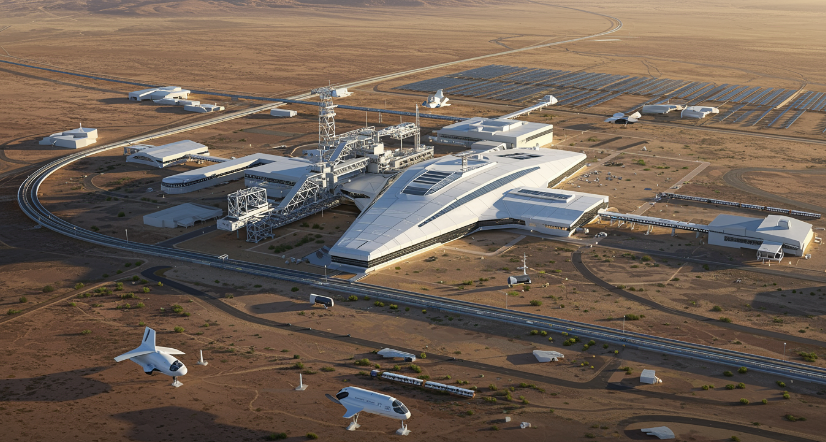
Nestled in the high desert of southern New Mexico, Spaceport America stands as a beacon of innovation and exploration. As the world’s first purpose-built commercial spaceport, it has already played host to pioneering companies like Virgin Galactic and UP Aerospace. But its story is just beginning. With ambitious plans on the horizon, Spaceport America is poised to become a central hub for the next era of spaceflight — one that includes not only tourism but also satellite deployment, research, manufacturing, and even intercontinental travel.
Strategic Vision for Growth
Over the coming decades, Spaceport America aims to expand from a niche launch facility into a full-fledged multi-user space complex capable of supporting a wide array of aerospace activities. This vision is being driven by both public and private stakeholders, including the New Mexico Spaceport Authority, NASA, and an increasing number of commercial space firms seeking flexible, scalable infrastructure.
1. Infrastructure Upgrades
To support increased traffic and more advanced spacecraft, Spaceport America is planning significant upgrades to its facilities:
- Runway Extensions : To accommodate next-generation vehicles requiring longer takeoff and landing distances.
- Vehicle Integration Facilities : Expanded hangars and integration centers will allow multiple companies to prepare spacecraft simultaneously.
- Mission Control Enhancements : A state-of-the-art control center is in development to handle concurrent launches and improve coordination with FAA and other regulatory bodies.
2. Diversification of Launch Capabilities
While suborbital tourism remains a core function, the future of Spaceport America lies in diversification:
- Small Satellite Launches : Partnering with companies like Vector Launch and Firefly Aerospace to provide cost-effective access to orbit.
- Hypersonic Flight Testing : Leveraging its vast airspace and remote location to become a testbed for hypersonic technologies, which could revolutionize global transportation.
- Vertical Launch Complexes : Plans are underway to develop pads for vertical rockets, broadening the types of missions the spaceport can support.
3. Research and Development Hub
Spaceport America is increasingly positioning itself as a center for scientific and technological innovation:
- University Partnerships : Collaborations with institutions like New Mexico State University and others to conduct microgravity experiments and train the next generation of aerospace engineers.
- Space Manufacturing Initiatives : Exploring opportunities in additive manufacturing and material science in low-gravity environments.
- Climate and Atmospheric Research : Hosting payloads and instruments designed to study Earth’s atmosphere and climate change from suborbital altitudes.
4. Economic and Workforce Development
Expansion isn’t just about technology — it’s also about people. Spaceport America aims to catalyze regional economic growth by:
- Creating thousands of high-tech jobs in aerospace, engineering, logistics, and hospitality.
- Establishing training programs and apprenticeships to build a skilled local workforce.
- Attracting ancillary industries such as space insurance, legal services, and satellite data analytics.
5. Sustainability and Environmental Responsibility
As the space industry grows, so too does the need for sustainable practices. Spaceport America is committed to minimizing its environmental impact through:
- Renewable energy initiatives, including solar power installations across the facility.
- Eco-friendly construction materials and green building standards.
- Monitoring and mitigating emissions and debris from launch operations.
6. International Collaboration
With the global space economy expanding rapidly, Spaceport America is exploring partnerships beyond U.S. borders:
- Hosting international launch providers and payloads.
- Participating in multinational research missions and satellite constellations.
- Serving as a diplomatic and commercial gateway for emerging space nations.
Looking Ahead: 2030 and Beyond
By 2030, Spaceport America could be launching dozens of missions per year, serving a mix of commercial, academic, and governmental clients. In the long term, it may evolve into a multi-modal transportation node, integrating air, space, and ground logistics systems.
Some futuristic scenarios include:
- Point-to-point hypersonic travel hubs connecting continents in under two hours.
- Lunar and Mars mission staging areas , where spacecraft are assembled and fueled before deep-space journeys.
- Space tourism hotels and visitor centers , offering immersive experiences for the public.
 Tech News FYP
Leave a comment