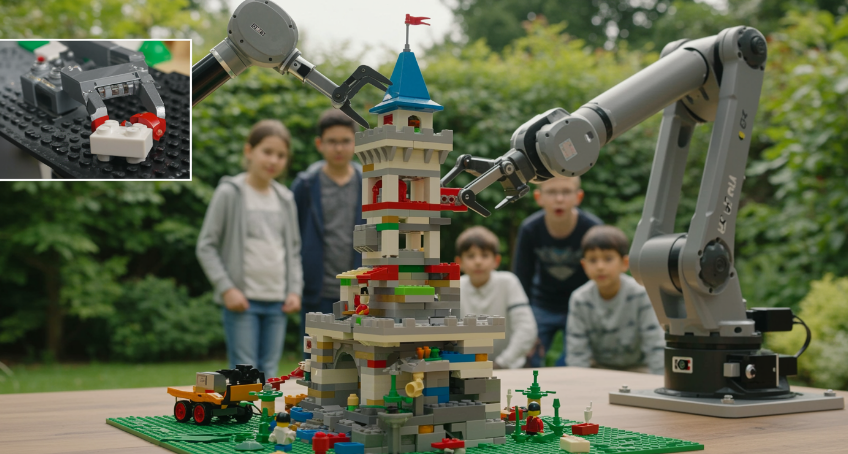
In a breakthrough that bridges the gap between digital intelligence and physical creativity, researchers have unveiled a new AI system capable of designing and assembling Lego models that are not only imaginative but also structurally sound in the real world. This innovation marks a significant leap forward in robotic construction and AI-guided design, offering exciting implications for education, engineering, and automated manufacturing.
How It Works:
The AI system, developed by a team of roboticists and AI experts, uses a combination of deep learning, 3D modeling, and physics-based simulations to generate blueprints for Lego structures. Unlike previous systems that focused purely on aesthetics or virtual assembly, this AI evaluates each proposed model for stability, weight distribution, and balance—ensuring that what it designs can actually be built and will stand upright without collapsing.
Once the design is finalized, a robotic arm equipped with precision sensors and grippers assembles the model piece by piece. The system continuously monitors the build process, making micro-adjustments in real time to correct misalignments or instability.
Key Innovations:
- Physics-Aware Design: The AI is trained on thousands of successful and unsuccessful Lego builds, allowing it to predict which designs will hold up in reality.
- Autonomous Assembly: With minimal human intervention, the robot can select and place bricks accurately, even adapting to variations in brick shape or placement errors.
- Creative Flexibility: Users can input general concepts (e.g., “build a castle” or “design a bridge”) and the AI generates multiple viable options, balancing creativity with practicality.
Applications Beyond Play:
While the system was tested using Lego bricks, its underlying principles could be applied to modular robotics, disaster-response construction, and even space exploration, where autonomous robots may need to assemble habitats or tools from standardized components.
Educational institutions are already showing interest in integrating similar AI-assisted building platforms into STEM curricula, helping students learn engineering fundamentals through interactive, AI-guided play.
Challenges Ahead:
Despite its impressive capabilities, the system still faces challenges when scaling to more complex or abstract designs. Fine-grained artistic details or highly intricate mechanical functions remain difficult for the current version to handle. However, the research team is optimistic that future iterations will incorporate multi-modal learning and improved tactile feedback to overcome these hurdles.
 Tech News FYP
Leave a comment